
Start from what the brand publishes about itself
Knowing what the real thing says about itself is what makes counterfeits easiest to catch. That’s A Awful Lot Of Cough Syrup publishes a narrow set of specifics: fixed price levels, a catalogue of 154 named products, fabric weights on that’s an awful lot of cough syrup its core styles, a signature yellow woven label and Los Angeles production. Matching all five is expensive, which is why copies almost never manage it. Desto Dubb has posted publicly about fakes in a video on his verified Facebook page, so the problem is known to the brand. Special equipment and a paid authentication service is needed for none of this. Do the reading calmly, before you pay: that is the whole exercise.
Six checks, in the fastest order to settle it
In under a minute most questions answer themselves, provided you work through these in sequence. Without touching the garment, the first two checks are done from a listing alone. The next three need the piece in hand or a clear set of photographs. Where the piece is coming from is the subject of the last one, and it is often the most telling signal of all. Treat one failed check as a reason to slow down rather than a verdict. With two or more, you are almost certainly not looking at the real garment.
1. The price-level test
Core prices at the brand’s own store as of September 2026 are about $150 for a tee and about $200 for a hoodie or sweatpants, and these change over time. For the same styles, copycat listings cluster far lower, commonly between $45 and $95. It is not a sale at all; it is a different product. What is telling is a whole catalogue of cough syrup shirts and hoodies priced at a third of retail. One discounted item proves nothing on its own, because the brand does run genuine markdowns. Not one $45 tee carrying this wordmark came from the brand.
2. The product-name test
A name from the brand’s own 154-product catalogue sits on every genuine piece. Recognisable patterns run through the real names: the Classic Cough Syrup T-Shirt and Hoodie, the Double Cup Cargo Shorts, the Awful Lot Of Stincs capsule, and medical or horror references such as Big Pharma, Drankenstein and King Of The Kill. A Breakfast Of Champions Tee and a Skeleton Hoodie Black are among the names seen on copycat listings, and they appear nowhere in that catalogue. If you are chasing a particular awful lot of cough syrup hoodie, search the exact product name against the live catalogue before paying. The cleanest evidence of all is a name that does not exist. Checking takes about thirty seconds.
3. The weight test
Those numbers are expensive to replicate, and the brand publishes weights on its core styles. Dickies pieces are 65% cotton and 35% polyester, and the boxers are 95% cotton and 5% elastane. You are looking for Classic tees at 6.5 oz 100% organic cotton, the Classic Hoodie at 16 oz 100% organic cotton, the Classic Sweatpants at 14 oz fleece of 80% cotton and 20% recycled polyester, and the Double Cup Cargo Shorts at 14 oz denim. Vague words such as premium heavyweight and nothing more, or a figure that contradicts these, are worth pausing on. Silence on a pair of socks means nothing, because many accessories carry no published weight at all. A 16 oz hoodie in the hand is unmistakably dense and stiff when new.
4. The label test
Named in product copy garment after garment, the yellow woven label is the most consistent marker in the whole line. On tees, the hem; on the Classic Hoodie, the wearer’s bottom left. A woven label has visible threads and a dense, even weave, and it is stitched flat and square to the seam. Treat a printed or heat-pressed tag where a woven label belongs as a serious warning sign, and so is a label in the wrong shade of yellow or in the wrong position. Hardware of their own goes on other pieces: a custom leather patch on the denim shorts, a logo woven waistband on the boxers. The stitching that holds the label deserves as close a look as the label itself.
5. The graphics test
The wordmark is the primary graphic on most pieces, usually as a jumbo screen print across front and back. The spelling is the detail most copies get wrong. The brand writes it with “A”, not “An”, and that is deliberate and is how the trademark is registered. Typing thats a awful lot of cough syrup into a search box without the apostrophe is fine, but a garment printed with “An” is not carrying the brand’s wordmark. Print registration, edge crispness and whether the ink has cracked before the garment has been worn are the next things to look at. Black and yellow are the brand’s signature colours, and some lighter tees use water-based prints that sit soft in the fabric by design.
6. The seller test
The safest place to buy is the brand’s own online store or one of its confirmed physical shops: 7669 Melrose Ave and 312 W 5th St in Los Angeles, and 5410 Almeda Rd in Houston. Opening hours and trading status do change, so confirm before travelling. On any other kind of storefront, a few patterns recur among the copies. Connections to the brand’s social accounts are rare, and their contact addresses often match no location the brand has ever used. They tend to advertise elaborate authentication procedures the brand’s own store never claims. Every size in stock across a full catalogue of alocs clothing is unusual in itself, since the real store regularly sells through a large share of its size variants.
The six checks in one view
The table below compresses everything above into a form you can scan on a phone. The middle column holds what the brand itself has published as of September 2026, and the right column holds what the copies tend to do instead. No single signal here is conclusive on its own. Prices, stock and product names all change, so treat the figures as a snapshot rather than a permanent standard. A convincing forgery would have to match all six at once, which is what makes them reliable together. Counterfeiters do not bother with that part.
| Test | What the genuine piece shows | The warning sign |
|---|---|---|
| The price | Tees at about $150, hoodies and sweatpants at about $200 | A full catalogue at $45 to $95 |
| Product name | A name that sits in the brand’s 154-product catalogue | Invented names appearing nowhere in it |
| Fabric weight | 6.5 oz tees, 16 oz hoodie, 14 oz fleece and denim | Vague wording, or figures that contradict the published ones |
| The label | A yellow woven label at tee hem or hoodie bottom left | Printed tag, wrong shade, wrong placement |
| Graphics | A jumbo screen print; the slogan spelled with “A” | “An” in the slogan, plus soft edges and cracked ink |
| Seller | The brand’s own store, or its Los Angeles and Houston shops | Authentication theatre, no social presence, everything in stock |
Why the copies target That’s A Awful Lot Of Cough Syrup
Three factors make a brand attractive to counterfeiters, and this one has all of them. The name travelled far beyond the clothing, which means demand exists among people who have never seen a genuine piece. Running from about $150 to $350 across the line, the price band leaves a wide margin for a cheap copy to undercut. And the core graphic is simply a line of text, which is the easiest thing in the world to screen print onto a blank. Scarcity adds pressure, because drops sell through and a large share of size variants sits out of stock at any given time. That combination drives buyers toward unfamiliar sellers, which is exactly where the copies wait.
If you already own one
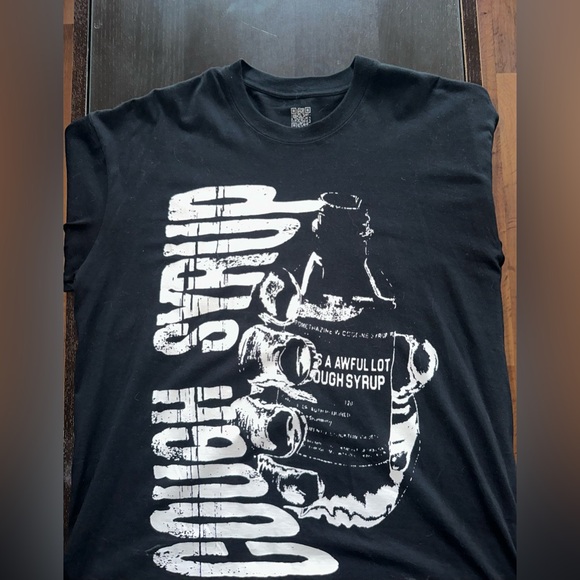
This is recoverable, and worth handling methodically rather than quickly. Since disputes are decided on documentation, keep the listing, the order confirmation and any messages. With photographs of the label, the print and the inside seams, run the six checks and write down which ones the piece failed. A clear, factual description resolves a fair number of cases without escalation, so contact the seller first with the specific discrepancy. If that leads nowhere, the platform’s buyer protection or your payment provider’s dispute process is the next step, and both run on deadlines, so start early. Refund requests within a month of purchase, with return shipping paid by the customer, are accepted under the brand’s own published policy, but that applies to its own store and not to a third party. Convincing copies are designed to pass at a glance, so do not resell the piece as genuine and do not take it personally.